Loading…
Flagship Institutional Workflow Platform
DIU Internal Workflow Management System
A role-based project, communication, reporting, and repository platform designed for Daffodil International University’s administrative hierarchy—from Chairman-level oversight to Registrar Office coordination and subordinate execution.
- Laravel
- MySQL
- Role-Based Access Control
- Project Workflow
- Institutional Operations
Project Snapshot
- Institution
- Daffodil International University
- System type
- Internal workflow and accountability platform
- Primary stack
- Laravel and MySQL
- Main domains
- Projects, tasks, communication, reports, repositories
- Access model
- Role-based institutional hierarchy
- Current maturity
- Functional internal system
Interface Preview
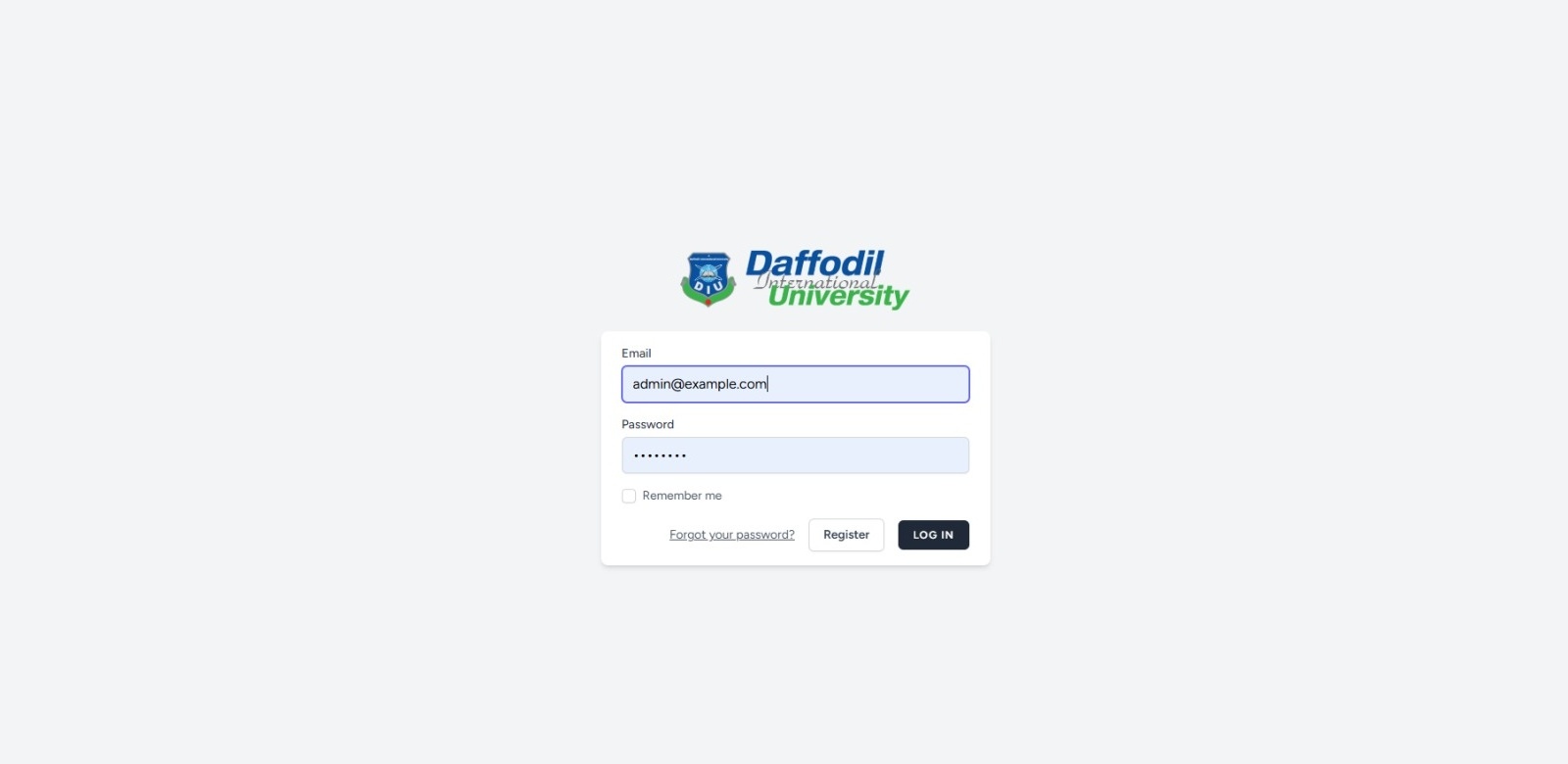
System Authentication & Portal Login — Secure authentication interface for university faculty, coordinators, and administrators.
Institutional Problem and Product Overview
Large institutional projects often involve senior oversight, administrative coordination, project management, departmental execution, reporting, and document exchange across several levels of responsibility. In institutions like Daffodil International University, coordinating these operations across academic and administrative departments poses a significant managerial challenge.
When these processes are handled through isolated messages, spreadsheets, email threads, and informal file sharing, responsibility becomes difficult to trace. Staff may not know which instruction belongs to which project, managers may lack reliable progress evidence, and documents can become disconnected from the decisions that produced them. This lack of centralized tracking creates operational drag and limits accountability.
DIU Internal Workflow Management System centralizes these activities around projects. It connects assignments, work items, project tasks, communication, progress reports, attachments, repository history, approvals, and role-based visibility within one controlled workflow. The platform is designed around accountability rather than general social communication. Every important operational activity remains connected to a project, responsible role, deadline, report, file, or review decision.
- Institutional project creation and oversight: Providing senior management with unified project views.
- Role-based responsibility assignment: Ensuring clear boundaries for tasks and reviews.
- Work-item planning: Grouping operations into distinct units of responsibility.
- Project-task execution: Direct assignment of executable items to coordinators and staff.
- Project-linked communication: Maintaining conversations and updates within the project context.
- Coordinator progress reporting: Gathering progress details and challenges for management review.
- Attachment and repository management: Storing project deliverables and historical records.
- Review and approval workflows: Multi-stage check gates for tasks and reports.
- Accountability and audit history: Tracking who did what and when across the platform.
- Project completion and archive lifecycle: Moving finished projects into a protected archive.
Role Hierarchy and Access Boundaries
The system supports an institutional hierarchy extending from senior oversight to operational execution. Access boundaries are strictly enforced to preserve security and compartmentalize work. Users see only the projects, tasks, and functions permitted by their role, preventing unauthorized access to sensitive academic or administrative files.
Role checks are performed server-side on the backend. Permissions block unauthorized users from deleting attachments, updating repository details, or viewing senior management decisions. This separation is crucial for maintaining administrative integrity in a large university.
| Role | Primary Responsibility | Typical Visibility |
|---|---|---|
| Senior Authority / Chairman | Institutional oversight, strategic project review, and global analytics. | Cross-project strategic information and high-level progress summaries. |
| Registrar Office / Admin | Administrative control, user approval, role assignment, and system governance. | Institution-wide operational configurations and system audit logs. |
| Project Manager | Project creation, assignment of coordinators, review, and escalation handling. | Assigned or managed projects, work items, and communication. |
| Coordinator | Day-to-day coordination, sub-task assignment, progress collection, and reporting. | Coordinated projects, assigned sub-tasks, and subordinate team context. |
| Subordinate Staff | Execute assigned tasks, upload work files, and submit progress updates. | Own assignments and permitted task context; no access to management tools. |
Important Role Boundary: The AI-assisted comparison or coordination features are designed exclusively for Administrators and Project Managers to review project reports and communications. Subordinate users have no access to these tools, preserving management-only evaluation boundaries.
Project, Work Item, and Task Model
To represent the university administrative structure, the database maintains a clear division between high-level containers and specific actions. This structure prevents messy lists of undifferentiated tasks and aligns operational work with strategic goals.
The platform defines three distinct layers of planning:
Project
The main container holding objectives, timelines, members, communication threads, reports, files, work items, and tasks.
Work Item
A managerial unit of responsibility representing a specific area of project scope assigned to a coordinator.
Project Task
An executable action item under a work item, supporting deadlines, assignee mappings, and status tracking.
Work items and tasks support different levels of planning. A work item helps management structure a broader responsibility (e.g., Syllabus Revision), while project tasks break that responsibility into specific actions (e.g., Draft Module A, Review Bibliography). This separation avoids duplication, as task updates automatically feed into work-item summaries.
Structural Mappings:
- Project → Work Items → Project Tasks → Assignees
- Project Tasks → Progress Updates & Completion Evidence
- Work Items → Coordinator Progress Reports → Review & Approval
Communication, Reporting, and AI-Assisted Coordination
Communication within the platform is strictly project-linked. Discussion threads exist under specific projects, work items, or tasks, ensuring that instructions and questions remain attached to their relevant context. This prevents critical decisions from becoming lost in separate email threads.
Formal progress reports originate from the coordinator-level workflow. While subordinate staff provide task updates and comments, coordinators are responsible for compiling these into formal project progress reports containing summaries, completed milestones, pending actions, and blockages.
The platform features a prototype AI-assisted comparison tool. This feature helps Project Managers and Administrators evaluate submitted progress reports against the initial checklist objectives. It flags missing items and highlights differences, allowing managers to identify incomplete requirements before approving the report.
- Project discussion, task comments, and administrative instructions are retained as context history.
- Notifications trigger automatically upon assignments, replies, and reviews.
- AI-assisted report comparison is restricted to Admin and Project Manager roles, requiring human validation before any final approval.
Repository, Attachments, and Auditability
The repository is designed to preserve the permanent documentary history of university projects. It holds project deliverables, signed documents, progress evidence, and reviewed file versions, making it an auditable archive of institutional activity.
Attachment deletion is permission-controlled. While coordinators can delete incorrect files they uploaded or files within their managed work items, they cannot erase general project history. Deletions are soft-recorded, and all file activity generates audit logs to ensure accountability.
| Operational Event | Audit Expectation |
|---|---|
| Project created or updated | Actor role, timestamp, IP hash, and details are logged. |
| Assignment changed | Previous assignee, new assignee, and delegating manager are recorded. |
| Task status changed | Workflow transition, reviewer notes, and completion states are stored. |
| Report submitted or reviewed | Report details, checklist matching records, and review notes are preserved. |
| Attachment uploaded or deleted | User identity, project context, file hash, and action timestamps are traced. |
Workflow Lifecycle and Approval Structure
Projects progress through a structured lifecycle that mirrors university administrative approvals. Completed projects lock down routine modifications while preserving their communication threads and files for future audits.
The system implements an automated retention policy: after a project has been marked as completed for 14 days, temporary coordination chats and draft working files are moved to archive storage. However, final reports, project metadata, audit logs, and approval records remain permanently accessible in the repository.
| Action Item | Submitted By | Reviewed By | Final Visibility |
|---|---|---|---|
| Task update / submission | Assigned staff | Coordinator or Project Manager | Project team workspace |
| Progress report submission | Coordinator | Project Manager or Department Head | Management hierarchy logs |
| Project completion approval | Project Manager | Senior Authority or Registrar Office | Permanent institutional repository |
Project Approval Pipeline:
- 01.
Project initiation
Project draft created and assigned roles by PM.
- 02.
Work-item planning
Coordinators map scope boundaries and set checklists.
- 03.
Task execution
Staff perform tasks and upload completion evidence.
- 04.
Report generation
Coordinators prepare and submit progress reports.
- 05.
Managerial review
PM checks tasks and reports using checklist comparison.
- 06.
Archive lock
Senior approval locks the project and schedules 14-day cleanup.
System Architecture and Database Design
The application uses the Laravel framework with a MySQL database. It is implemented as a secure, server-rendered web application that enforces role-based access checks at the route, controller, and query levels.
Institutional User
Authenticated Web Interface
Laravel Routes and Controllers
Authorization Policies and Middleware
Project and Workflow Services
MySQL Database
Notifications, Audit Events, and Repository Storage
| Layer | Verified Technology |
|---|---|
| Application | Laravel 11, PHP |
| Interface | Blade templates, Tailwind CSS, JavaScript |
| Database | MySQL 8.0 (indexed tables, transactional locks) |
| Authorization | Laravel Gates, Policies, and Role Middleware |
| Testing | PHPUnit, database seeders, and integration mocks |
The database schema is designed for relational integrity and auditability. Below are the primary entities managed by MySQL:
| Entity Table | Responsibility |
|---|---|
| users | User identity, department mapping, role approval state, and auth credentials. |
| projects | Project metadata, owner ID, deadline, department scope, and overall status. |
| project_members | Associates users with projects and overrides roles within project context. |
| work_items | Managerial work divisions belonging to projects, assigned to coordinators. |
| project_tasks | Executable items, checklists, task status, deadlines, and parent work item mapping. |
| communications | Project-linked messages, system-generated logs, and comments. |
| progress_reports | Coordinator report summaries, submission status, and revision review notes. |
| attachments | Uploader details, soft-delete metadata, file hashes, and parent entity links. |
| audit_logs | Append-only logs of critical transitions, overrides, and permission actions. |
Engineering Evidence, Security, and Limitations
The system ensures security and validation at both application and database boundaries. Sensitive actions (like role changes or task overrides) generate detailed audit records, and database constraints prevent conflicting state changes.
Security controls are integrated into the core architecture:
- Authentication required for all protected workspaces: Access is blocked until identity is approved.
- Server-side role enforcement: Access checks run in controllers and policies, preventing front-end bypass.
- Project-scoped queries: Users query only the projects they are member of, preventing data leakage.
- File-upload validation: Strict checks on MIME types, file sizes, and storage directories.
- Audit trails: Log events recorded for administrative overrides and completed milestones.
- Database level protections: Parameterized SQL queries via Eloquent ORM to prevent SQL injection.
The following project limitations apply to the current implementation:
- Frontend validation is separated from the backend; Javascript errors do not compromise database security.
- The 14-day auto-cleanup rule runs via Laravel's task scheduler; manual database overrides require administrative logs.
- No public repository or public application URLs are available because this is an internal university tool.
- AI-assisted report comparison is an experimental prototype and requires manual manager verification before approval.
Current Status and Future Development
The system is fully functional within Daffodil International University's intranet workspace. Its maturity status is summarized below:
| Capability | Status |
|---|---|
| Project management | Implemented |
| Work items | Implemented |
| Project tasks | Implemented |
| Role-based access | Implemented |
| Project-linked communication | Implemented |
| Coordinator progress reports | Implemented |
| Attachment management | Implemented |
| Repository history | Implemented |
| Audit logging | Implemented |
| AI-assisted comparison | Implemented |
| Archive lifecycle | Implemented |
| Notifications | Implemented |
| Automated testing | Implemented |
| Live deployment | Implemented |
Future development priorities for the system include:
- Adding visual interface indicators to guide users between work items and tasks.
- Introducing file diff tools to support complete attachment version histories.
- Building custom email template editors for notification configuration.
- Extending sitemap and search filters to allow complex cross-project query matching.
- Adding automated archive restore protocols for authorized administrators.